This guide explains how to interpret 226 Cf, why the notation is associated with californium, and why Cf-226 should not be treated as a routinely established isotope without authoritative verification. It reviews isotope notation, nuclear stability, database checking, research context, safety requirements, and common labeling errors. The discussion distinguishes confirmed nuclear data from theoretical possibilities and informal references.
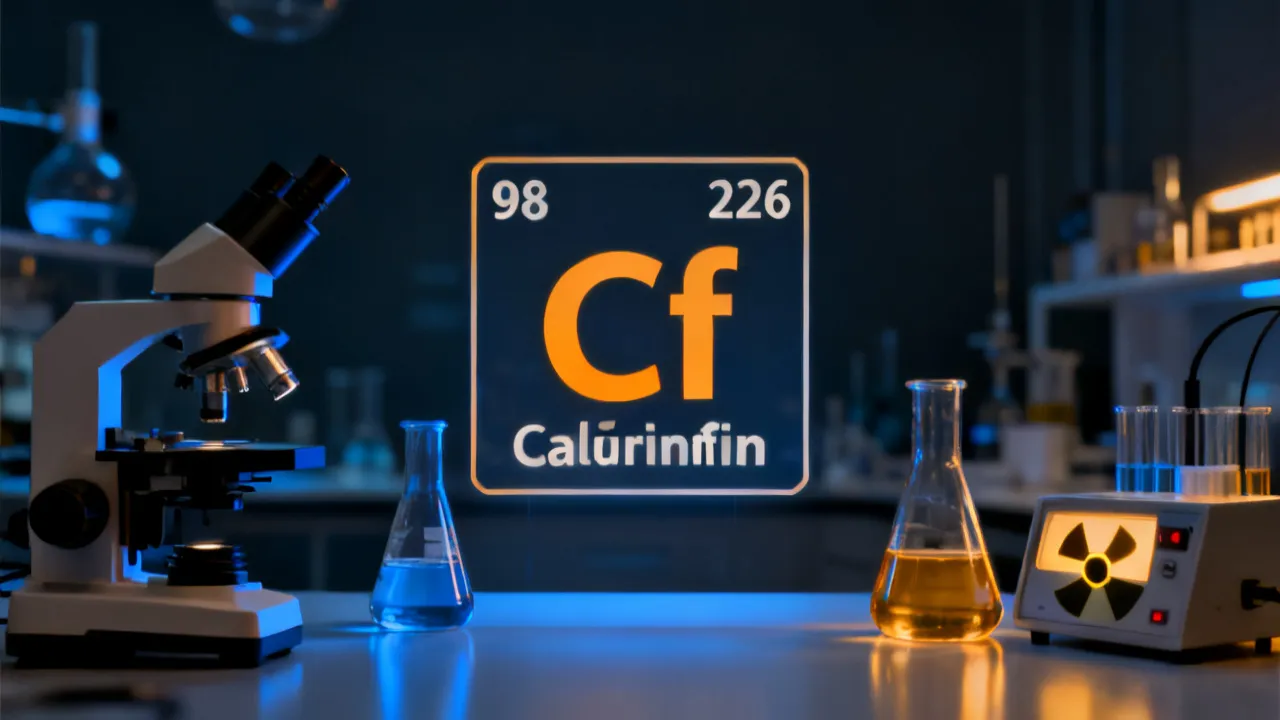
The notation 226 Cf is very naturally interpreted as a reference to a californium nuclide with mass number 226, commonly written in scientific formats as ²²⁶Cf, Cf-226, or californium-226. Californium is element 98 on the periodic table, so every californium atom contains 98 protons. If the mass number is 226, the corresponding nucleus would contain 128 neutrons, calculated as 226 minus 98.
That arithmetic is straightforward, but the existence and status of a nuclide require much more than a notation exercise. A mass number can describe a proposed, predicted, historical, or experimentally observed nuclear species. Therefore, the appearance of “226 Cf” in a document, database, product listing, scanned table, or search query should not automatically be taken as proof that a routinely recognized californium-226 isotope is available or commercially supplied.
From an industry expert’s perspective, the central issue is verification. Established nuclear data should be checked against authoritative evaluated sources, including the National Nuclear Data Center, the Atomic Mass Evaluation, the Evaluated Nuclear Structure Data File, the International Atomic Energy Agency’s nuclear data resources, and current specialist chart-of-nuclides databases. These resources distinguish measured nuclides from theoretical predictions and help identify typographical errors, transcription problems, and outdated terminology.
Major evaluated nuclear-data references generally identify californium isotopes in a substantially heavier mass region than 226. A citation to 226 Cf should therefore be treated as an item requiring confirmation rather than as an ordinary isotope specification. It may reflect an incorrect reversal of numbers and letters, an OCR error, a mistaken reference to another element, or a theoretical nuclear-model entry. The correct interpretation depends on the original context.
Nuclear notation contains two different kinds of information: the identity of the element and the total number of nucleons in the nucleus. The chemical symbol Cf identifies californium. Its atomic number, 98, is normally omitted from the short form because the element symbol already determines it. The number 226 is the mass number, representing protons plus neutrons.
The formal nuclide notation is often shown as:
²²⁶₉₈Cf
In this expression, the upper-left number is the mass number and the lower-left number is the atomic number. In ordinary technical writing, the shorter forms Cf-226 and ²²⁶Cf are more common. The search phrase 226 Cf places the mass number before the element symbol, which is understandable but less precise than the standard typographic format.
| Notation element | Meaning | Relevance to 226 Cf |
|---|---|---|
| Cf | Chemical symbol for californium | Identifies element 98 |
| 226 | Mass number | Represents the total number of protons and neutrons |
| 98 | Atomic number | Indicates the number of protons in every californium nucleus |
| 128 | Calculated neutron number | 226 minus 98, if the proposed nuclide were considered |
The neutron calculation does not establish whether the nucleus has been observed. It only describes the composition implied by the notation. In nuclear physics, this distinction is essential: a mathematically definable nucleus is not necessarily a confirmed or practically accessible isotope.
The atomic number and mass number should not be confused. The atomic number, represented by Z, is the number of protons. It determines the element’s identity. If a neutral atom has 98 protons, it is californium regardless of how many neutrons it contains. The mass number, represented by A, is the sum of protons and neutrons. In the expression ²²⁶Cf, A is 226 and Z is 98.
The neutron number, commonly represented by N, is obtained from the relationship N = A − Z. For the notation under discussion, N would be 128. If the atom were ionized, its number of electrons could differ from 98, but its nuclear identity would remain unchanged. Chemical ionization does not alter the mass number or transform one isotope into another.
This basic distinction is useful when reviewing technical documents. A number printed beside an element symbol might be a mass number, atomic number, activity value, catalog identifier, or a reference number. Only its location, formatting, heading, and surrounding units establish what it means. The string “226 Cf” resembles a nuclide label, but context remains necessary.
Isotope names influence laboratory planning, radiological controls, transport documentation, waste management, detector calibration, and scientific interpretation. An incorrect mass number can change the expected decay mode, half-life, radiation spectrum, shielding calculation, production route, and regulatory classification. For a heavy radioactive element such as californium, an error in identification can have consequences far beyond a spelling mistake.
Californium is a synthetic actinide. It is not encountered as an ordinary naturally occurring element in the environment, and its isotopes are produced in specialized nuclear facilities. Because the element is radioactive and generally available only in tightly controlled research or industrial channels, isotope identity must be supported by a certificate, a recognized nuclear-data record, or a primary research publication.
An expert review normally asks five questions:
If a record answers only the first part of the question—by displaying “226 Cf” without a source—it is insufficient for procurement, experiment design, or radiation-safety decisions. A responsible reader should avoid inferring availability or physical properties from the label alone.
Even when a nuclide is experimentally confirmed, that does not mean it exists in a form that can be purchased, stored, transported, or used in routine laboratory work. Some nuclides have been observed only in minute numbers of atoms during short-duration experiments. Their existence may be established through decay chains, correlated detector events, or mass measurements, while no macroscopic sample is ever accumulated.
Commercial availability requires a separate chain of conditions. A production facility must be able to create the nuclide in useful quantities, separate it from target and daughter products, characterize the resulting material, package it safely, and meet licensing requirements. A nucleus may be scientifically real but commercially irrelevant because it decays too quickly, is produced at an extremely low rate, or cannot be separated before transformation.
Californium belongs to the actinide series, a group of elements associated with progressively occupied 5f electron shells. Its atomic number is 98, placing it after berkelium and before einsteinium. Like other heavy actinides, californium has complex nuclear behavior and is generally studied through its radioactive isotopes rather than through stable samples.
The chemical symbol was derived from California, where the element was first reported by researchers at the University of California, Berkeley, in 1950. The discovery involved nuclear reactions that produced a new element with atomic number 98. This historical background explains why californium appears in nuclear research, but it does not imply that all proposed californium mass numbers are equally established.
Nuclear stability in the actinide region is controlled by the balance between the strong nuclear force, which binds nucleons, and electrostatic repulsion among the many positively charged protons. As proton number rises, the nucleus becomes increasingly vulnerable to alpha decay, spontaneous fission, beta-related transformations, or combinations of these processes. Shell effects and neutron-to-proton balance can improve stability in particular regions, yet very proton-rich or very neutron-rich configurations may be difficult to produce and short-lived.
A hypothetical californium nucleus with mass number 226 would contain 98 protons and 128 neutrons. That neutron count places it in a proton-rich portion of the chart relative to the commonly studied heavier californium isotopes. Whether such a nucleus could be produced, how rapidly it would decay, and what daughter products it would form would require specialized theoretical and experimental analysis. It should not be assigned a half-life or radiation profile without a reliable source.
In light elements, changing the neutron number can already alter stability and decay behavior. In heavy actinides, the effect is even more pronounced because the nucleus contains a large number of mutually repelling protons. Additional neutrons can change the balance between attractive nuclear interactions and proton-proton repulsion. They also alter shell occupancy, pairing effects, deformation, and the energy barriers associated with fission.
For this reason, an apparently small change in mass number can produce a substantial change in nuclear behavior. Two californium isotopes may share chemical properties because they have the same number of protons and electrons, yet differ greatly in half-life or radiation emissions because their nuclei contain different numbers of neutrons. Chemical similarity therefore cannot be used to infer nuclear similarity.
Nuclear charts often include more entries than the set of nuclides that have been measured with equal confidence. Some nuclei have precisely determined masses and decay properties. Others have been observed only through a small number of decay events. Still others appear in theoretical calculations as possible combinations of protons and neutrons.
These categories should not be merged:
The phrase 226 Cf has no scientific value as a confirmed identification unless its status is established. A theoretical entry can be important in nuclear-structure research, but theoretical relevance is different from material availability. This distinction is particularly important for search-engine results, marketplace pages, classroom documents, and automatically generated catalogs, where a valid-looking nuclide label may be repeated without verification.
Experimental confirmation can take several forms. Researchers may observe a characteristic decay sequence, identify a known daughter nucleus, measure a mass-to-charge ratio, or detect radiation with energies consistent with a particular nuclear transition. In many cases, the strength of the identification comes from several linked observations rather than from a single measurement.
Evaluators then compare results from different experiments, account for uncertainties, and determine whether apparently conflicting observations can be reconciled. The resulting data record may include confidence levels, recommended values, known excited states, and references to the original measurements. A source that merely lists a nuclide name without any indication of evidence level provides less information than a formal evaluation.
For a rare and potentially short-lived species, the evidence may remain provisional for years. Scientific caution is not a weakness in such cases. It allows future measurements to refine or correct the record without confusing a tentative assignment with a settled fact.
A careful investigation begins with the original document rather than with a general web search. The surrounding text may reveal whether the term refers to isotope notation, a page number, a sample code, a figure label, or a software variable. The order of the characters may also matter. “226 Cf” could be a reversed form of “Cf-226,” but it could also be a damaged conversion of another entry.
Record the complete sentence, table heading, document title, publication date, author, and any nearby units. If the term appears on a label, photograph the entire label rather than copying only the isotope-like text. A single missing character can change an element identity or mass number.
Check that “Cf” is capital C followed by lowercase f. Chemical symbols are case-sensitive. “CF” may be an abbreviation, a material code, or a formatting error rather than californium. The element symbol should be checked against a current periodic table or an official element reference.
Search current records from recognized nuclear-data organizations. Useful resources include the National Nuclear Data Center’s chart and decay databases, the Evaluated Nuclear Structure Data File, the Atomic Mass Evaluation, and relevant IAEA data services. Compare the mass number, half-life, decay modes, energy levels, and daughter nuclides.
Determine whether the entry is measured, evaluated, provisional, predicted, or absent. An absent entry should not be filled in with values copied from an unrelated isotope. If a source presents a value without a reference, look for the original experiment or evaluation.
A classroom exercise may use the notation to test neutron-number calculations. A nuclear-model paper may discuss a predicted region of the chart. A supplier document, by contrast, must identify a real material with traceable activity and regulatory documentation. The required level of proof depends on the use case.
If the reference affects an experiment, purchase, transport decision, or radiation-control plan, consult a qualified health physicist, nuclear chemist, or nuclear-data specialist. Informal interpretation is not an adequate substitute for institutional review when radioactive materials are involved.
Compare the proposed isotope with every other value in the record. Does the stated daughter nuclide follow the proposed decay mode? Does the reported radiation energy belong to the same isotope? Is the activity reference date plausible? Are units being used consistently? Internal contradictions often reveal that a label was copied from a neighboring row or that multiple isotopes were combined during data entry.
| Possible interpretation | What it could mean | Recommended response |
|---|---|---|
| Standard isotope notation | A reference intended to mean californium with mass number 226 | Verify its status in current evaluated nuclear-data records |
| Formatting variation | The writer used “226 Cf” instead of “Cf-226” or “²²⁶Cf” | Normalize the notation while preserving the original wording in records |
| OCR or transcription error | A scanned document or copied table altered the original isotope label | Compare the text with the source image and nearby entries |
| Theoretical nuclide | A model calculation concerns a nucleus not established as a routine measured isotope | Use the model’s definitions and do not treat it as a purchasable material |
| Catalog or sample code | The characters identify an internal item rather than a nuclide | Ask the issuing organization for the code legend and material identity |
| Reference to another element | The number or symbol was misread, abbreviated, or copied incorrectly | Check the original source and verify the atomic number independently |
This comparison is deliberately cautious. It does not assign a definitive physical status to 226 Cf without documentary evidence. In technical communication, a qualified uncertainty is more useful than an unsupported assertion.
Californium isotopes are produced through nuclear reactions and subsequent chemical separation, generally in highly specialized facilities. Production may involve neutron irradiation, successive nuclear transformations, or accelerator-based reactions, depending on the isotope and the desired quantity. The route is influenced by target material, neutron flux or beam energy, competing reactions, decay losses, radiochemical separation, and the required isotopic purity.
For established californium products, a legitimate technical specification normally includes the isotope designation, reference date, activity, chemical or physical form, radionuclidic purity, chemical purity, calibration method, and measurement uncertainty. Transport classification and packaging information may also be required. A label that contains only “226 Cf” lacks the information needed to evaluate identity or suitability.
It is also important to distinguish an isotope from a source assembly. A source may contain a californium compound deposited on a substrate, sealed in a capsule, or incorporated into a device designed for neutron production. The source’s output depends on isotope composition, activity, geometry, self-absorption, encapsulation, and age. The isotope name alone does not describe the device’s performance.
Because californium is radioactive and potentially hazardous, procurement is restricted to organizations with appropriate licenses, trained personnel, secure storage, radiation monitoring, and approved procedures. A request for a rare or unverified isotope should undergo additional scrutiny. Claims of immediate supply, exceptional purity, or unusually simple handling should be checked against a formal certificate and the relevant regulator’s requirements.
A facility can report that it produced a target material without proving that every atom in the resulting sample belongs to the requested isotope. Nuclear reactions often generate mixtures of isotopes, activation products, daughter products, and residual target material. Chemical separation can improve elemental purity, but isotopes of the same element require additional characterization because they share chemical behavior.
Reliable product identification may therefore involve gamma spectroscopy, alpha spectrometry, mass spectrometry, decay-growth analysis, or other validated methods. The measurement method must be appropriate to the nuclide and its expected emissions. A generic radiation reading cannot by itself establish an isotope’s mass number.
Any material identified as californium should be treated as a radioactive source until qualified personnel establish otherwise. The appropriate response is not to open, test, transport, or chemically process the material independently. Instead, isolate the item according to institutional procedures, prevent unauthorized access, and contact the radiation-safety officer or designated authority.
Core requirements commonly include:
The exact requirements depend on jurisdiction, activity, source form, intended use, and transport conditions. National regulators and institutional radiation-protection offices should be consulted before acquisition or movement. Regulatory compliance cannot be inferred from a web listing or a supplier’s informal description.
An uncertain label creates two separate risks. First, personnel may underestimate the hazard if they assume the material is inactive or belongs to a different isotope. Second, they may apply the wrong controls if they assume a radiation type or energy spectrum that has not been established. The safest administrative response is to treat the item as an unidentified radioactive material and use the organization’s established escalation process.
Documentation is part of safety. Inventory records should link the physical container to its certificate, source number, activity measurement, location, responsible custodian, and inspection history. If the label conflicts with the inventory, the discrepancy should be recorded and investigated rather than silently corrected.
It is tempting to infer the behavior of 226 Cf from better-known californium isotopes. That approach is unreliable. Nuclear decay properties vary substantially with neutron number and nuclear structure. A neighboring isotope may have a different dominant decay mode, half-life, spontaneous-fission probability, gamma spectrum, or daughter sequence.
For a verified isotope, scientists examine several parameters:
For 226 Cf specifically, these values should not be invented or borrowed from Cf-249, Cf-250, Cf-251, or Cf-252. If an article, label, or data sheet supplies decay information for 226 Cf, the values should be traced to an identified measurement or evaluation. Without that traceability, the information remains unverified.
Half-life describes the intrinsic probability of decay for a particular nuclear state. Activity describes the number of decays occurring in a sample per unit time. Activity depends on both the amount of radionuclide present and its half-life. A label that reports an activity value but omits the isotope, reference date, and measurement uncertainty is incomplete.
For long-lived materials, the activity may change slowly over a practical period. For short-lived materials, the reference date becomes especially important because the activity can decrease substantially between calibration, shipment, receipt, and use. This is another reason that a mass-number label alone cannot serve as a complete material specification.
Some readers may assume that 226 identifies an element. It does not. The atomic number of californium is 98, while 226 is a mass number. The two values describe different properties.
A nuclear chart can include scientific possibilities that are not available as isolated samples. Product availability requires production capability, measurable activity, chemical processing, quality assurance, licensing, and an appropriate use case.
Half-life and radiation data cannot safely be transferred from one isotope to another simply because the element symbol is the same. The mass number determines the neutron count and strongly influences nuclear behavior.
In a damaged PDF or OCR output, superscripts may move into the main line, subscripts may disappear, and symbols may be mistaken for letters. Reviewing the original typography can resolve the problem.
Search results are useful for locating documents, but they are not a substitute for peer-reviewed literature or evaluated databases. A repeated claim may still originate from one transcription error.
Nuclear evaluations are updated as new measurements become available. A specialist should record the database version or publication date when citing nuclide information. This practice allows another researcher to reproduce the verification process.
A nuclide may exist in a ground state or in one or more excited states. Some excited states are sufficiently long-lived to receive separate designations, while others decay too quickly to be treated as independent materials. A database entry may include an isomeric state, and an omitted “m” or excited-state marker can produce ambiguity. When reviewing a rare isotope reference, the state designation should be checked as well as the mass number.
When the status of a nuclide is unclear, careful wording prevents later confusion. A research note might state: “The source uses the label 226 Cf; current verification of its nuclide status is pending.” This is preferable to rewriting the record as a confirmed isotope.
A robust documentation entry should contain:
If the label is shown to be an error, preserve the original text in an audit trail and add the corrected identification separately. Deleting the original without documentation can make it difficult to explain why a record changed.
When evidence is incomplete, terms such as “reported,” “proposed,” “listed by the source,” “not independently verified,” and “predicted by the cited model” can communicate the situation accurately. Terms such as “confirmed,” “available,” “commercially supplied,” or “well-established” should be reserved for claims supported by appropriate evidence.
This distinction is especially valuable when a report will be read by people outside nuclear physics. A general reader may regard any entry in a table as equally real and equally obtainable. An explanatory note prevents that misunderstanding without requiring the reader to know the entire history of nuclear-data evaluation.
| Requirement | Why it matters | Evidence to request |
|---|---|---|
| Element confirmation | Prevents confusion between similar symbols or codes | Verified chemical symbol and atomic number |
| Mass-number confirmation | Distinguishes one isotope from another | Nuclide notation supported by a recognized data source |
| Decay information | Supports radiation protection and measurement planning | Evaluated half-life, decay modes, and emission data |
| Material traceability | Connects the label to a real sample or source | Certificate, batch record, or institutional inventory entry |
| Regulatory authorization | Confirms lawful possession and handling | Relevant license, permit, or institutional approval |
| Measurement quality | Indicates whether the reported activity is dependable | Calibration details, reference date, and uncertainty |
These conditions apply especially when 226 Cf appears in a procurement request or source inventory. For a theoretical discussion, the documentation may focus more heavily on the nuclear model, assumptions, and publication record. In both cases, the reader should know whether the subject is an observed material or a calculated nuclear configuration.
A dependable verification pathway begins with evaluated nuclear-data organizations. The National Nuclear Data Center provides widely used databases covering nuclide properties, decay schemes, and nuclear structure. The Evaluated Nuclear Structure Data File compiles reviewed information on nuclear levels and transitions. The Atomic Mass Evaluation addresses masses and related uncertainties. The International Atomic Energy Agency maintains nuclear-data services and technical resources used by researchers and regulators.
Primary research literature can add experimental detail, particularly when a nuclide has limited observations or recently revised measurements. Peer-reviewed papers should be read alongside evaluations because individual experiments may report preliminary or narrowly scoped results. A specialist should check whether later evaluations accepted, modified, or rejected the original interpretation.
For safety decisions, regulatory publications and institutional procedures are also essential. A nuclear-data record may explain what a nuclide is, but it does not by itself authorize possession, shipment, or use. Radiation-safety rules are established by the relevant national or regional authority and may differ according to activity and source configuration.
A practical source hierarchy is:
The lower levels can help locate terminology, but they should not be used alone to confirm the existence, properties, or availability of 226 Cf.
Nuclide databases are living technical resources. New mass measurements, revised decay schemes, improved detector calibrations, and reinterpreted experiments can change recommended values. Two documents produced years apart may therefore contain different half-lives, branching ratios, or confidence classifications.
When citing a database, record its title, version, access date, and relevant entry. If a discrepancy appears between two sources, do not automatically select the larger or newer-looking number. Determine whether the sources refer to different nuclear states, different evaluation methods, or different reference dates. A transparent record of the comparison is often more valuable than a single unexplained value.
Although the specific status of 226 Cf requires verification, californium as an element has recognized importance in nuclear science. Certain californium isotopes are valued for their neutron emissions and have been studied for applications involving neutron sources, reactor physics, materials analysis, and specialized measurement systems. Such applications depend on isotope-specific properties and carefully engineered source designs.
In neutron-related work, the source’s emission rate and spectrum are only part of the analysis. Geometry, shielding, moderation, scattering, attenuation, detector efficiency, and background radiation all affect the measured result. The chemical form and encapsulation can also influence handling and performance. Consequently, a scientist would never select a californium source by element symbol alone.
Californium also illustrates a broader principle in nuclear engineering: rarity and technical value do not eliminate the need for routine quality controls. Each source must be identified, measured, tracked, inspected, and managed according to established procedures. A questionable isotope label is therefore a quality-assurance issue as well as a scientific issue.
Some established californium isotopes have been used as compact neutron sources because their decay can generate neutrons through spontaneous fission. The usefulness of such a source depends on the neutron yield, energy distribution, source strength, physical design, and intended measurement. A source for instrument calibration may have different requirements from one used in research, industrial inspection, or nuclear safeguards.
Even in these applications, the isotope is only one component of the engineering specification. The source must be shielded and encapsulated, the output must be characterized, and the assembly must be periodically inspected. Any claim that an unverified californium label corresponds to a functioning neutron source should therefore be treated with caution.
Authors preparing content about 226 Cf should avoid presenting uncertain information as settled fact. The strongest editorial approach is to define the notation, explain the verification issue, and direct readers toward authoritative nuclear-data sources. If the term comes from a particular publication, the article should identify that context and preserve the distinction between the author’s claim and the current consensus.
Technical writers should also avoid unsupported numerical claims. Do not assign a half-life, price, production volume, radiation dose, or commercial availability unless the information is documented and relevant to a clearly identified isotope and source type. Pricing is especially difficult because legitimate radioactive materials are quoted according to activity, chemical form, calibration date, licensing, transport, and institutional eligibility—not simply by isotope name.
Search-engine optimization should not reduce scientific precision. The keyword 226 Cf can be included naturally in headings and explanatory paragraphs, but repetition without added meaning can mislead readers and weaken the article. Variants such as Cf-226, ²²⁶Cf, and californium-226 should be used only to clarify notation.
Editors should also distinguish an explanatory article from a procurement guide. An article explaining the meaning of a nuclide label can discuss atomic number, mass number, neutron count, and verification methods. A procurement guide must additionally address licensing, certificates, activity, transport, source integrity, and institutional authorization. Combining these categories without clear boundaries can cause readers to mistake general scientific information for operational approval.
They are intended to express the same isotope notation: californium with mass number 226. However, the notation alone does not confirm that the nuclide has been experimentally established or that a material with this identity is available. The status must be checked against current nuclear-data records.
Cf is the chemical symbol for californium, element 98. Every californium atom contains 98 protons. The number placed before or above the symbol is normally the mass number, not the atomic number.
If the notation describes a californium nucleus with mass number 226, the neutron number would be 128. This is calculated as 226 minus the atomic number 98. The calculation describes the proposed composition but does not prove that the nuclide has been observed.
It should not be treated as a routinely supplied isotope without authoritative confirmation. Established californium materials are associated with specific isotopes, certificates, activities, and regulatory controls. A reference to 226 Cf requires verification before any assumption about availability or handling.
No. Isotopes of the same element can have markedly different half-lives, decay modes, radiation emissions, and production routes. Data from Cf-252 or another isotope should not be transferred to 226 Cf unless a recognized nuclear-data source explicitly supports the comparison.
It may appear in theoretical discussions or model-based charts, but its status must be determined from the specific source. A predicted nuclear configuration is not equivalent to a confirmed sample. The source should state whether the entry is measured, evaluated, provisional, or theoretical.
The laboratory should follow its radioactive-material incident or verification procedure. Personnel should not open or manipulate the container to investigate the label. The radiation-safety officer or qualified responsible person should review the inventory, secure the item, inspect documentation, and arrange appropriate measurement or expert identification.
A legitimate technical package should identify the radionuclide, activity and reference date, chemical or physical form, radionuclidic and chemical purity, calibration method, uncertainty, packaging, transport classification, and relevant authorization details. If the supplier provides only a name and a mass number, the record is incomplete.
Possible explanations include a formatting variation, OCR failure, transcription error, internal sample code, theoretical model entry, or an intended but unverified isotope reference. The surrounding document and original source image should be reviewed before deciding what the phrase means.
Researchers should consult current evaluated nuclear-data resources from organizations such as the National Nuclear Data Center and the International Atomic Energy Agency, together with the Atomic Mass Evaluation, nuclear-structure files, and peer-reviewed literature. For possession or transport decisions, the relevant regulator and institutional radiation-safety office must also be consulted.
No. The neutron count identifies the proposed nuclear composition, but stability depends on the detailed balance of nuclear forces, shell structure, pairing, deformation, and available decay pathways. A nucleus with a particular proton-to-neutron ratio may be theoretically possible yet highly unstable or difficult to observe.
Usually, a general radiation reading cannot establish a mass number. Isotope identification requires an appropriate measurement method, calibrated instrumentation, suitable energy resolution, and interpretation by qualified personnel. Documentation and nuclear-data comparison are also important because several radionuclides can produce overlapping or complex signals.
The phrase 226 Cf is best approached as a notation requiring scientific verification. It points to a proposed californium nuclide with mass number 226, while californium itself is element 98 and would contribute 98 protons to the nucleus. The implied neutron count is 128, but that calculation should not be confused with experimental confirmation.
A reliable assessment depends on context, current evaluated data, source traceability, and regulatory documentation. Researchers and technical readers should distinguish observed isotopes from theoretical entries, avoid borrowing decay information from other californium isotopes, and treat any material labeled 226 Cf as requiring qualified review. This evidence-based approach protects both scientific accuracy and radiation safety.
Striking the Perfect Balance: Navigating Premiums and Out-of-Pocket Expenses in Senior Insurance Plans

Explore the Tranquil Bliss of Idyllic Rural Retreats

How to Make Lasting Memories at Disneyland Attractions

Affordable Phones and Plans for Seniors

Affordable Full Mouth Dental Implants Near You

Unlock the Top Kept Secrets to Finding Your Ideal Dentist for Flawless Dental Implant Results!

Discovering Springdale Estates

Unveiling RS Sul Telecom Services

The Guide to Car Trading

Striking the Perfect Balance: Navigating Premiums and Out-of-Pocket Expenses in Senior Insurance Plans
Finding an optimal mix of insurance premiums and direct medical costs is crucial for effective healthcare budgeting. This discussion will delve into tactics to achieve a balance that aligns with your finances.
Unlock the Top Kept Secrets to Finding Your Ideal Dentist for Flawless Dental Implant Results!
Selecting an adept dentist is critical for ensuring the efficacy and your satisfaction during a dental implant procedure. This in-depth guide is designed to assist you in finding a dental expert who meets your personal requirements, guaranteeing that your path to dental implant success is seamless and fruitful.

Protect Your Perfect Smile: Master the Art of Defending Your Teeth Against Acid Attacks
Though they may tantalize the palate and invigorate the senses, foods and drinks with high acid content are a double-edged sword with regard to oral wellness. Continual exposure to these substances progressively strips away the protective enamel from our teeth, which can lead to increased sensitivity, changes in coloration, and a variety of other dental complications. This composition offers insight into relishing these zesty favorites while safeguarding your teeth from damage.

Discovering Heartis Eagle Mountain
Heartis Eagle Mountain is a prominent senior living community that offers a range of services and amenities aimed at enhancing the quality of life for its residents. Situated in a peaceful setting, it combines exceptional care with engaging activities, providing a holistic environment that caters to seniors' physical, emotional, and social needs.

Unveiling the Top Dental Implant Options for Seniors: Transform Your Smile with the Ultimate Guide to Restored Radiance
The significance of oral health cannot be understated for the elderly population as they are commonly afflicted with tooth loss due to a multitude of factors, including decay and gum disease. Dental implants have risen to prominence as a prime method of teeth replacement, acclaimed for their long-lasting nature, functional prowess, and striking similarity to our own teeth. This discussion delves deeply into the realm of dental implants to demonstrate why they are considered the optimal choice for aged individuals aiming to enhance their smiles and overall life quality.

Boost Your Defenses: 20 Proven Strategies for a Stronger Immune System
Having a robust immune system is essential to protect our bodies from harmful microorganisms and preserve our general health. Although some elements that affect our immunity are out of our hands, many lifestyle decisions can help us enhance our immune defenses naturally. This piece delves into 20 practical methods to empower your immune system, increasing your capacity to ward off diseases and sicknesses.